
Sound waves turn porous materials into tiny pumps for drug delivery, filtration
James Friend’s lab develops acoustofluidic device to move fluid faster than diffusion
Porous materials are excellent for storing liquid used in energy and underground water storage and biomedical devices such as pregnancy or rapid virus tests. They easily absorb fluid, but don’t move fluid through as easily.
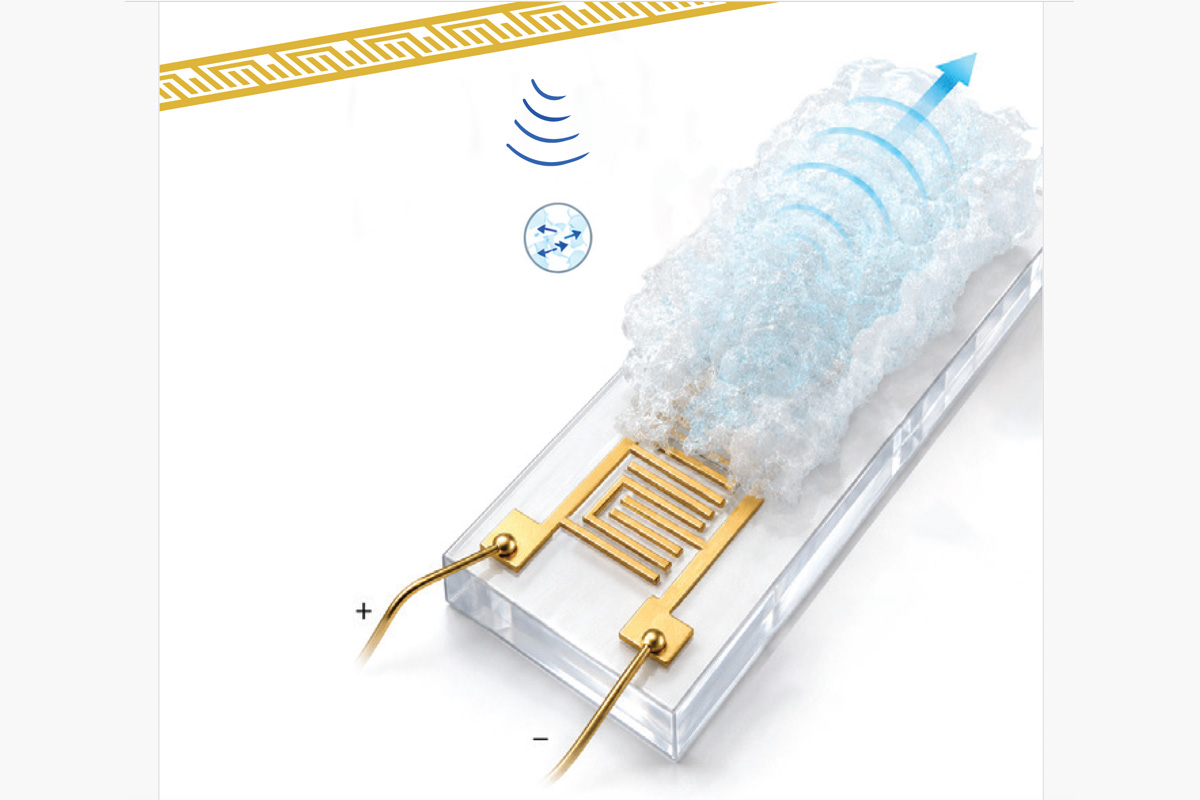
James Friend, the Stephen F. & Camilla T. Brauer Distinguished Professor and chair of the Department of Mechanical Engineering & Materials Science in the McKelvey School of Engineering at Washington University in St. Louis, and collaborators from around the globe developed a device that uses sound waves to pump fluid through various types of porous materials. Such a device could be used to deliver drugs efficiently, as a diagnostic device, in fuel cells, and to filter and separate chemicals, among other uses.
Results of their research were published July 15, 2026, in Advanced Functional Materials.
Sujith Jayakumar, a doctoral student who led the work in Friend’s lab in collaboration with Ofer Manor, professor of chemical engineering at the Technion – Israel Institute of Technology, used a floating-electrode unidirectional transducer (FEUDT) to send surface acoustic waves in one direction. The sound waves created tiny forces in the liquid that help pump it through the pores. The device worked more efficiently than conventional devices with wet surfaces, with a directional flow of up to 0.6 mm per second at sub-watt power, or more than 600 times faster than diffusion alone.
“This mechanism has never been well explained, and we’ve figured out a significant part of the story,” Friend said. “It would be nice to be able to look at much larger samples and flow, and this allows us to do that in the same way with fuel cells and water collection.”
The device is essentially a mechanical way to squeeze fluid out of the porous material, like wringing out a wet cloth, Friend said.
The researchers tested the device on several porous materials, first with it dry and next with it wet, and found that it worked just as well when the material was wet, unlike traditional sound wave devices. They found the best results when the pore size was close to the wavelength of the sound.
In addition, they tested it on skin of a preclinical model, on which could be used to deliver drugs not only on top of the skin, but deep enough to be absorbed. While a similar move has been tested in the past, the team’s approach allowed for controlled, long-range and directionally guided flow through the tissue.
“With ultrasound, the problem is that you have a difficult time driving flow across the skin or flow in just beneath the sealed layer of the skin to deliver the drugs at a useful level to sit at the surface of the skin to be absorbed, similar to a tattoo,” Friend said. “This device will enable us to actually get a drug into the interstitial tissues where it can get picked up by the vascular system so that it’s not just a local drug delivery, but a systemic delivery.”
Friend said their research shows how passive porous materials can be converted into actively pumped transport platforms. Going forward, they plan to produce flow in porous material with much smaller pores, though the device’s size is limited because the sound waves fade out before they can travel very far.
Jayakumar S, Parathi J, Onuh G, Guo F, Manor O, Friend J. Turning porous functional materials into directional transport platforms with unidirectional surface acoustic waves. Advanced Functional Materials, online July 15, 2026. DOI: https://doi-org.libproxy.washu.edu/10.1002/adfm.77065
Funding for this research is provided by the U.S. Office of Naval Research (13423461), the National Science Foundation (ECCS 2314118), University of California San Diego and Washington University in St. Louis.